A Late-Summer Walk Along a Southern Main Street
A late-summer walk along a Southern Main Street can reveal how shade, storefront thresholds, and shared street space shape an ordinary afternoon.
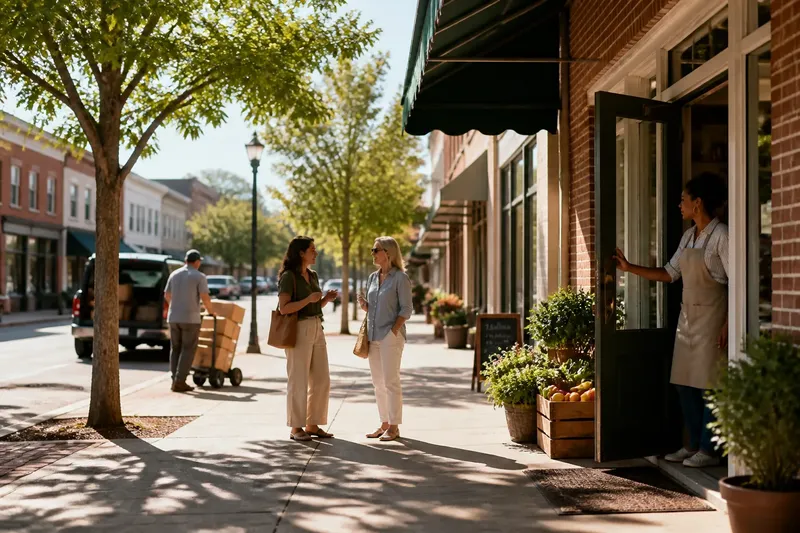
On a late-summer afternoon, a shopkeeper props open a door while a band of shade reaches across the sidewalk. A delivery cart pauses near the curb; two neighbors slow to talk without blocking the entrance. A late-summer walk along a Southern Main Street can hold scenes like this in plain view—not as proof of a regional character, but as glimpses of how people share a particular street at a particular hour.
Imagine Lena, a fictional visitor to Bellweather, an invented town. She has half an hour before meeting a friend at the library and chooses to walk one stretch of the main street instead of driving. Her purpose is modest: notice where the afternoon invites people to pause, and where it asks them to keep moving. She begins with no route beyond the next intersection.
Where does the shade fall?
Lena starts at a corner where a brick storefront meets a narrow side street. The awning shades only the entrance, while a young street tree throws a smaller patch across the paving. She notices the difference between shade that is attached to a building and shade that shifts with the tree’s canopy.
That distinction matters to the walk’s feel. A deep awning may shelter a person waiting at a window, but it can leave the rest of the sidewalk exposed. A tree’s shade may be broken and temporary, yet it can soften the stretch between doors. Neither feature tells Lena how comfortable the whole street is. She has to look at where shade actually lands along her route.
She also notices the time. The shadow from a sign reaches across one doorway, then narrows as the street opens toward an unshaded parking lot. The observation is useful without requiring a map or a judgment about the town. A different hour could produce a different walk.
What does a storefront threshold invite?
At a small grocery, the threshold is legible: a mat, a window display, and a door that opens directly onto the sidewalk. Farther along, a barber shop has a recessed entrance and a bench set close to the wall. A café’s outdoor table sits near its doorway, leaving a clear passage beside it.
Lena looks at these edges as places where public movement meets private business. A window can offer a reason to pause without requiring a purchase. A bench can make waiting feel welcome, though it may belong to the business rather than the street. A door propped open can suggest easy entry, but the sound and activity inside remain part of the shop’s own space.
She avoids guessing what a building’s owner intends. Instead, she watches what the setup allows: someone can stop at the display without obstructing the door; a person entering the café can pass the table; a customer on the bench can see the sidewalk. These small arrangements make the street readable. They do not make every threshold equally accessible or welcoming.
How do people share the narrow parts?
Near the next block, the sidewalk narrows where a utility pole and a sandwich board stand close together. A person with a stroller pauses, turns slightly, and waits while another pedestrian passes. No one makes a scene of it. The delay lasts long enough for Lena to notice, then the two continue in opposite directions.
That moment gives her a more grounded way to think about shared space than a general impression of friendliness. She can see where people yield, where they pass, and whether an obstacle changes the route. She also sees how a curb cut, a clear doorway, or a gap beside outdoor seating can matter to someone moving at a different pace.
On the next block, a delivery worker rolls a hand truck toward a shop. A couple steps aside near a tree pit, and the worker steers through the open section of sidewalk. The street is not simply a place for leisurely strolling. It is a working route, a waiting place, and a path through town at once.
What changes as the afternoon moves on?
At the library corner, Lena stops in the shade of a broad canopy. The street sounds different from the earlier block: a screen door closes, a truck passes, and a few voices drift from the grocery entrance. She does not treat these sounds as evidence of a single Southern pace. They belong to this street, on this afternoon, among people carrying out ordinary errands.
The scene also changes as the light shifts. The shaded patch near the library grows thinner, while the grocery awning still covers its doorway. Someone who walks the same stretch later might encounter a busy lunch crowd, a quiet closing hour, or a sudden shower. A seasonal walk is attentive to conditions, not a claim that every day follows the same pattern.
Lena turns back toward the library by a parallel block. There, the buildings sit close to the sidewalk, but the trees are sparse. A row of parked cars interrupts the view into the storefronts. The comparison is not a verdict on either street. It helps her understand how shade, setbacks, and the placement of vehicles shape what she can see and where she can comfortably pause.
What questions help explain a walk like this?
What should I notice on a late-summer walk?
Look for where shade reaches the sidewalk, how doors and windows meet the public path, and what happens when people need to pass one another. Treat each observation as specific to that block and hour.
How can I tell whether a storefront threshold is shared space?
Notice whether the area is clearly part of a business, a public sidewalk, or a mix of both, and whether people can pass without entering or buying anything. If ownership is unclear, describe what you see rather than assuming who controls it.
Why does the same street feel different from block to block?
Canopies, awnings, building setbacks, parked vehicles, and sidewalk width change from one stretch to the next. Those details affect light, sound, and the room people have to move or pause.
How can I observe without turning people into a spectacle?
Keep attention on the setting and the shared movement rather than following or photographing strangers. If a person’s private conversation or activity is not necessary to describe the street, leave it out.
What does Lena carry away from Bellweather?
By the time Lena reaches the library, she has a handful of observations rather than a formula for reading every Southern town. She can recall the awning that sheltered a doorway, the narrow sidewalk that made two pedestrians wait, and the tree shade that ended before the next intersection. Each detail has a place and a time attached to it.
That is the useful result of her invented walk: a casual route becomes more attentive without becoming an inspection. On a late-summer walk along a Southern Main Street, noticing shade, thresholds, and shared passage offers a way to understand how an ordinary block works for the people who use it. The next time Lena returns, she can look again—and let the street be different.