The Courthouse Square as a Town’s Public Room
The courthouse square reveals how Southern towns organized civic life, commerce, and public gathering—and why its role differed from place to place.
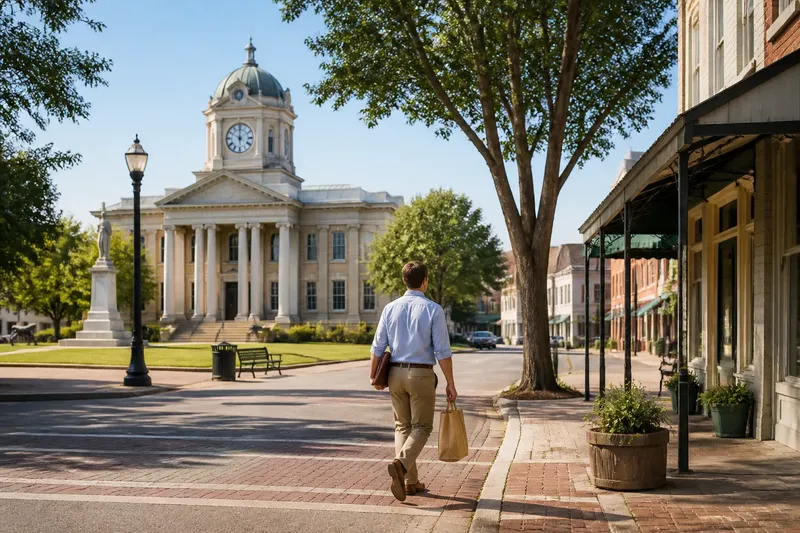
On a weekday morning, a courthouse clock marks the hour while someone crosses the square with a folder under one arm and a paper sack in the other. The scene looks familiar across much of the South, but a courthouse square was never simply a courthouse with a lawn around it. Its form arose from choices about land, government, trade, and access, and those choices gave each town a different kind of public room.
To understand the square’s history, it helps to read it as a civic arrangement rather than a fixed style. The building at the center mattered, but so did the streets feeding into it, the businesses along its edges, the people permitted to use it, and the work that brought them there. Over time, those parts could reinforce one another or pull apart.
How did the courthouse square become recognizable?
County government created a reason to gather in one place. Courts convened, records were kept, taxes and other public business were handled, and residents traveled from surrounding farms and settlements to transact with officials. A courthouse gave those duties a visible address. When the government site also shaped the town’s street plan, the civic building could become the organizing point for a wider district.
There was no single Southern blueprint. Some towns placed the courthouse in an open square at the center of intersecting streets. Others set it within a broader public reservation, on a rise, or along a prominent road. The arrangement depended on the land available, the town’s founding plan, local decisions about public property, and whether the settlement grew around an existing route or market.
Where streets approached the courthouse from several directions, the building could serve as both destination and landmark. The open space around it gave the structure room to be seen and provided a place for people to pause before entering. A compact square also put shops and offices within a short walk, making civic errands part of a larger trip into town.
The arrangement became recognizable through repetition, not because every place copied an identical model. Visitors came to expect a courthouse near the center of county business, and residents learned the square as a practical point of orientation. The familiar pattern was a family resemblance: central government, converging routes, and a surrounding business district, adapted to local conditions.
What work did the square bring together?
In an agricultural county, a courthouse trip could be tied to selling, buying, meeting, or hearing news. People might combine a court appearance with a stop at a store, an office, or a place to eat. Lawyers and public officials had reason to work nearby. Merchants benefited from customers arriving for county business, while the courthouse gave the commercial district a steady civic anchor.
The square’s public character came from this overlap. It was not only a ceremonial setting for official buildings or public occasions. It was also part of the ordinary geography of errands. Someone who had no reason to enter the courtroom could still pass the courthouse, use the adjacent sidewalks, or visit a business facing the square.
That shared use did not make access equal. A courthouse could represent public authority while its practices excluded people by race, gender, wealth, or legal status. In Southern history, the courthouse was a place where decisions about property, labor, citizenship, and justice could be made under deeply unequal systems. The appearance of an open square should not be mistaken for an open civic life.
That distinction matters when a town interprets its central space today. A square can preserve evidence of collective life and also carry the memory of who was denied a voice in the institutions around it. Reading the place carefully means noticing both the invitations built into its layout and the barriers upheld by its history.
Why did squares differ from town to town?
Geography shaped the available choices. A level site could accommodate a neat grid and a central open block; a steep slope, stream, or established road might produce a less regular plan. The courthouse might sit on the highest visible ground, or it might occupy a convenient parcel near the town’s commercial routes. A central location on a map did not always mean an easy walk for everyone arriving from the county.
Local economies also altered the square’s daily rhythm. In a county seat serving farms and small settlements, court days and market activity could bring crowds from outside town. In a place with manufacturing, rail connections, or a larger professional district, the courthouse might share attention with depots, factories, or newer business streets. The same basic arrangement could therefore function as a busy exchange point in one town and a quieter civic landmark in another.
Some courthouse squares enclosed a green or planted open space. Others were mostly paved, with the courthouse close to the street. A lawn could suggest a formal center, but it might be difficult to cross or offer little shade. A paved square could be more directly connected to shops and sidewalks, yet provide less room for sitting or public gatherings. Neither form tells the whole story without attention to how people actually used the surrounding streets.
Courthouse buildings changed, too. Fire, deterioration, renovation, and new government needs could alter the central structure while leaving the street pattern intact. In some towns, a newer building replaced an older courthouse on the same site; elsewhere, public offices moved and the old center lost some of its function. The square’s identity could persist after its original daily purpose had weakened.
How can you read a square as a historical record?
Begin at a public sidewalk and notice how the streets meet. Do they point toward the courthouse, bend around an open block, or connect the square to a highway or former rail corridor? The approach reveals what the plan makes prominent. A building that faces several arriving streets sends a different civic signal from one tucked behind a parking area or screened by later construction.
Then look at the edges. Storefronts, offices, churches, vacant lots, arcades, and parking spaces tell different stories about the square’s relationship to town life. A continuous line of small businesses suggests that civic visits and commerce once shared a compact setting. Large gaps may reflect demolition, changing property use, road widening, or businesses relocating. Treat those clues as prompts for local investigation, not proof of a single cause.
Notice where a person can stop without buying anything or entering an office. Benches, shade trees, public steps, broad sidewalks, and sheltered corners affect whether the square supports lingering as well as passing through. If a space feels formal but offers no comfortable place to pause, its design may favor institutional presence over everyday gathering.
Say you are visiting an invented county seat where the courthouse sits inside a small planted square, but most nearby storefronts are empty and the busiest road skirts the center. You might compare a historic map with the current street plan, note which entrances face public sidewalks, and ask a local historical society what businesses or public uses once occupied the edges. The expected result is not a complete account from a single visit, but a clearer set of questions about when the center’s activity shifted and what remains visible.
What questions help explain a courthouse square?
Why are courthouses often near the center of town?
A central site could make county government easier to locate and connect it with nearby streets and businesses. But the courthouse’s position reflects local land decisions and geography, not a universal rule that every town followed.
Was the courthouse square always a gathering place?
It could be a gathering place for some residents and an unwelcoming or inaccessible setting for others. Its uses changed with public policies, business activity, transportation, and the people allowed to participate in civic life.
Why do some courthouse squares have lawns and others do not?
Open space depended on the original plan, the parcel, and later decisions about roads, buildings, and public grounds. A lawn may have been part of the initial design or a later alteration, so the present appearance alone cannot settle its history.
What is the difference between a courthouse square and a courthouse green?
The terms overlap in ordinary use, but “square” often describes the town-center arrangement and its surrounding streets and businesses, while “green” emphasizes planted open space. Local usage varies, and the layout is more informative than the label.
What changed when civic life moved elsewhere?
Cars, expanded roads, and new commercial districts altered how people reached county seats. When offices, shopping, or parking shifted away from the old center, the square could lose routine foot traffic even if the courthouse remained. A public building may continue to anchor the map while no longer anchoring the town’s daily errands.
That change is not always a simple story of decline. Moving a service can make it easier for some residents to reach, while leaving the older center with empty storefronts or less activity. A restored courthouse can draw attention without restoring the networks of local businesses and public uses that once surrounded it. Preservation of a building and renewal of a civic district are related, but they are not the same task.
Some towns respond by adapting the courthouse’s neighbors for offices, housing, cultural spaces, or local services. Others use the square for public events or maintain it as a landmark. The best choice depends on what residents need and what the existing buildings and streets can support. A plan that treats the square only as a picturesque backdrop may preserve its appearance while leaving its public life thin.
What should a visitor notice today?
Look for the relationship between the courthouse, the edges, and the routes people actually take. Is the main entrance easy to reach from the sidewalk? Do local businesses face the square, or do blank walls and parking lots turn away from it? Is there shade or a place to sit, and does the street feel comfortable to cross? Such observations connect the town’s historic form to its present use without assuming that every old arrangement deserves to remain unchanged.
For a fuller account, compare the present layout with a locally held map, photograph, or property record, then ask how the square served different residents at different times. A county historical society or public library may help identify changes that the physical scene cannot explain. Where public memory is contested, seek accounts from more than one community, particularly from people whose families were excluded from official institutions.
The courthouse square remains legible because it places government in a shared landscape. Its meaning, however, lies beyond the courthouse façade: in the paths leading there, the businesses at its edges, and the people who could make use of the place. That is why a useful visit ends with one practical question: what public need does the square serve now, and who can reach it easily?