The Plantation Past Is Not the Whole Story of Southern Food
Southern food has no single origin story. Learn how to read a dish through Indigenous, African, European, and changing household influences.
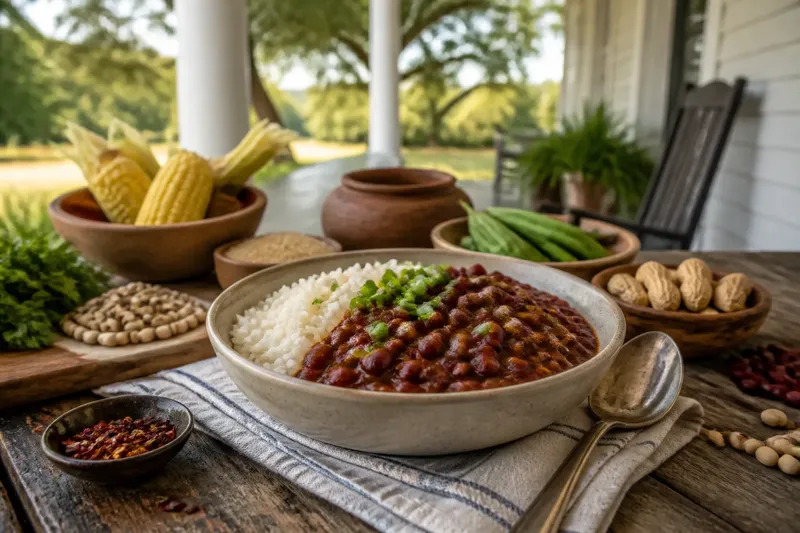
A bowl of red beans and rice can carry more than one history to the table. Its ingredients, cooking methods, and place in a household may point toward different communities and different moments. Southern food is often explained through plantation life, but that account is too narrow to explain the region’s foodways. A better approach asks what kind of origin story a dish invites us to tell—and what that story leaves out.
Why do Southern dishes get single-origin stories?
A dish with a familiar name can seem to have a fixed birthplace and a tidy line of descent. But recipes travel, change, and take on new meanings. A food might be associated with one state, town, or community while drawing on ingredients and techniques that crossed many boundaries.
Plantation slavery shaped Southern food profoundly. Enslaved people cultivated crops, raised livestock, prepared meals, and preserved knowledge under coercion. Their skill and labor were central to the food economy, while owners controlled much of the land and the proceeds. Naming that power is essential. Treating plantation kitchens as the whole origin of Southern cuisine, however, makes the enslaved people who created and sustained food traditions seem like supporting characters in someone else’s story.
Single-origin accounts also make food easier to package. A dish becomes “the” food of a place, and its history becomes a short tale with a clear beginning. The neatness can conceal the movements of people, the availability of ingredients, and the difference between a meal served in an enslaved person’s quarters and one served in a landowner’s dining room. Those meals belonged to the same unequal society, but not to the same experience.
What changes when we compare three ways of telling the story?
There are several useful ways to approach a regional dish. None cancels the others, but each foregrounds a different kind of evidence. The best choice depends on whether you are tracing a technique, explaining a local identity, or trying to understand how a recipe changed in ordinary homes.
What does an ingredient-and-technique account reveal?
This approach follows what cooks used and how they handled it. Corn, rice, okra, peanuts, and field peas have histories tied to different peoples, environments, trade routes, and forms of labor. A technique such as pounding, smoking, drying, or slow simmering may connect to knowledge passed between generations, though a technique alone rarely proves a dish’s exact origin.
This account suits a reader who wants to understand a dish’s material history: what grew in a region, what could be stored, and what cooks knew how to do with it. It is less suited to making a single community the sole owner of a food. The ingredients may have arrived by different routes, and their uses may have changed as cooks adapted them.
What does a community-and-place account reveal?
This approach asks who made a dish locally, when it appeared in a particular setting, and how neighbors came to recognize it as theirs. A food associated with a coastal town may reflect fishing, local crops, migration, and the work of specific households or businesses. The connection to place is real even when the recipe has relatives elsewhere.
This account suits someone interested in regional identity and community memory. It can also help distinguish a local variation from a broad category. Its limit is that a strong local claim may hide outside influences or overlook people whose work went unrecorded. Place tells us where a practice took root, not necessarily where every part of it began.
What does a household-change account reveal?
This approach follows a recipe through changing circumstances: a family moves, a market starts carrying a new ingredient, a cook adapts a dish for a larger gathering, or a written recipe replaces an informal routine. It treats change as part of tradition rather than evidence that tradition has been lost.
This is often the most useful approach for explaining why versions of one dish differ. It suits readers comparing family memories, community cookbooks, restaurant menus, or recipes recorded at different times. It cannot recover every earlier version, but it can show how food knowledge responded to available ingredients and the needs of the people cooking.
How do Indigenous and African foodways fit beyond plantation accounts?
Indigenous food knowledge predates European settlement and continues in Southern communities. Cultivation, gathering, fishing, processing, and seasonal knowledge shaped what could be eaten and when. Corn-based foods, for instance, should not be treated as though their Southern presence began with plantation households. Their histories involve Indigenous knowledge and later exchanges, adaptations, and uses.
African foodways also cannot be reduced to plantation conditions. Enslaved Africans brought and developed knowledge of crops, flavoring, preservation, and cooking while living under forced labor. Their descendants carried, adapted, and renewed those traditions in homes, churches, workplaces, and businesses. The conditions were violent, but the food knowledge was not simply a product of slavery; it drew on histories that existed before captivity and continued after emancipation.
European food practices matter too, as do later arrivals and movements within the South. Wheat baking, dairy use, curing, and particular seasoning traditions varied by place and household. These influences met one another unevenly, under unequal conditions. Calling the result “mixed” should not blur who held power or who supplied coerced labor.
What questions help explain a dish without flattening it?
Does a dish have one true origin?
Often, there is no reliable way to name one starting point for a food that developed through shared ingredients and changing practice. It is more precise to distinguish a dish’s known local association from the older histories of its components or techniques.
How can a recipe reflect both coercion and creativity?
People can create and preserve knowledge under unjust conditions without those conditions deserving credit for the knowledge itself. A careful account names forced labor and restricted access to food, while also recognizing the ingenuity and cultural continuity of the cooks.
What if two communities claim the same dish?
Consider whether they mean the same recipe, a related preparation, or a shared regional tradition with distinct local forms. Overlapping claims may reflect migration and exchange rather than a contest with one winner.
How should a family recipe be described?
Say what is known: who made it, where the family lived, what ingredients appear, and how the recipe changed. If an earlier connection is uncertain, describe it as a family account or possibility rather than established origin.
How can you choose an approach for the story you want to tell?
Start with the question that brought you to the dish. If you want to know how an ingredient or cooking technique entered a regional kitchen, follow the materials and methods. If you want to understand why a town identifies with a dish, begin with community and place. If you want to explain why family versions diverge, follow household change over time.
Say you are writing about a fictional family’s greens, made with smoked meat, vinegar, and a cooking liquid saved for another meal. The family says the recipe came from an older relative, but no earlier account is available. You could describe the known household practice, then ask how preservation, available ingredients, and local food customs may have shaped it. The expected result is a grounded account that distinguishes family memory from a claim about the dish’s regional origin.
When a claim names a particular people or place, look for the kind of evidence that fits it: a family’s recollection, a community cookbook, oral history, a local menu, or a record of agricultural practice. These sources answer different questions. A menu can show that a dish was served in a restaurant; it cannot, by itself, establish who first made it.
What does a fuller Southern food story make visible?
A fuller account does not remove the plantation past. It places that past within a larger, more accurate history of Indigenous knowledge, African creativity and continuity, European practices, migration, work, and household adaptation. It also keeps distinctions clear: cultural influence is not the same as equal power, and a dish’s local identity is not proof of a single origin.
For Southern food, the most useful question is often not “Who invented this?” but “Which people, places, and changing circumstances shaped the version we recognize?” That question leaves room for documented histories and family memory alike. It gives a reader a better way to describe the food in front of them—and a reason to be careful when a complicated dish is made to tell a simple story.